
• Security Team • 8 min read
AI-Powered Attacks on E-Commerce Stores: Emerging Threats, Real Cases, and Defensive Strategies
Introduction: Why AI Changes the Threat Landscape
Artificial Intelligence is transforming cybercrime. Instead of manually crafting phishing emails, scanning websites, or impersonating people, attackers now use AI to automate, scale, and personalize attacks.
For e-commerce businesses, this means:
- More convincing scams
- Faster exploitation of vulnerabilities
- Larger-scale bot attacks
- Harder-to-detect fraud
Security researchers and industry reports confirm that generative AI is accelerating existing attack vectors rather than inventing entirely new ones.
7 Emerging AI Threats to E-Commerce
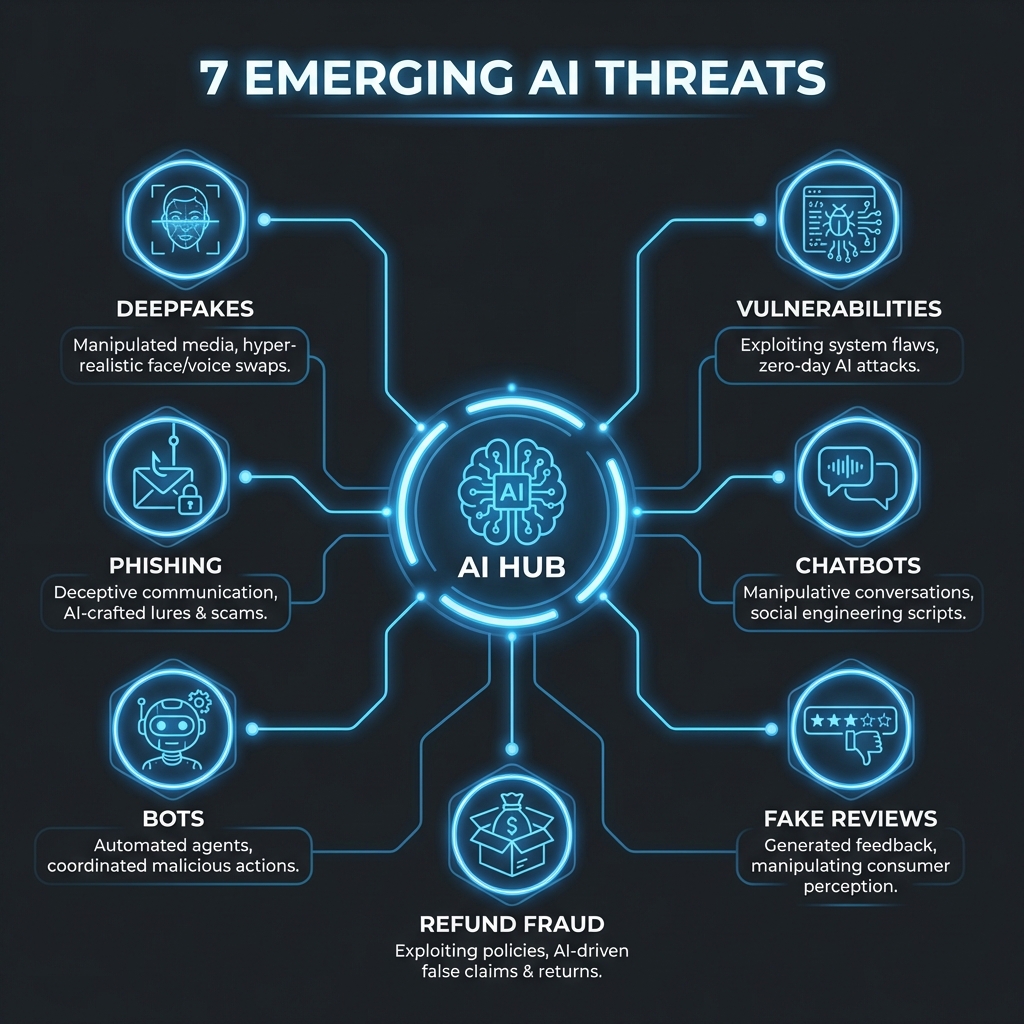
1 Deepfake Social Engineering and Synthetic Identity Fraud
What it is
Attackers use AI-generated voice or video to impersonate executives, suppliers, or employees to manipulate staff into transferring money or granting access.
Real-world evidence
-
⚠️
The Guardian: A major deepfake scam targeted the engineering firm Arup, where an employee was deceived during a video call with AI-generated executives and transferred a large sum of money. Read Source →
-
⚠️
World Economic Forum: Highlighted deepfake-driven cybercrime as a growing systemic risk. Read Source →
Impact on e-commerce
- Fake requests to change payout details
- Fraudulent refund approvals
- Admin account creation via impersonation
- Supply chain manipulation
2 AI-Generated Phishing and Brand Impersonation
What it is
Generative AI produces highly convincing phishing emails, SMS messages, and fake websites, often localized in multiple languages and personalized using scraped data.
Evidence and research
-
⚠️
TechRadar: Retail brands are among the most spoofed in phishing campaigns, with Amazon and delivery services heavily targeted. Read Source →
-
⚠️
Kaspersky: Reported millions of blocked phishing attempts targeting online shopping and payment systems. Read Source →
3 AI-Enhanced Bot Attacks and API Abuse
What it is
Bots use AI to mimic human behavior, evade detection, and adapt in real time. They target login pages, checkout flows, APIs, and pricing systems.
Evidence and research
-
⚠️
Akamai: API Security Impact Study shows retail and e-commerce as prime targets for automated attacks and API abuse. Read Source →
-
⚠️
Imperva: Generative AI is accelerating bot development and increasing automated traffic complexity. Read Source →
4 Automated Vulnerability Exploitation Using AI
What it is
AI assists attackers in discovering vulnerabilities, writing exploit code, and scanning thousands of websites for weaknesses in plugins, themes, APIs, and configurations.
Evidence and research
-
⚠️
KELA AI Threat Report: Cybercriminals are using AI to accelerate vulnerability research and exploitation workflows. Read Source →
-
⚠️
Heise: AI’s potential to accelerate zero-day discovery and exploit development. Read Source →
5 AI Risks in Chatbots and LLM-Powered Support Systems
What it is
Attackers exploit AI chatbots via prompt injection to extract data, bypass policies, or trigger unauthorized actions.
Evidence and research
-
⚠️
OWASP Top 10 for LLM Applications (2025): Lists prompt injection, data leakage, and insecure tool usage as top risks. Read Source →
6 AI-Generated Fake Reviews and Reputation Manipulation
What it is
AI systems generate large volumes of realistic product reviews to manipulate rankings or damage competitors.
Evidence and research
-
⚠️
ScienceDirect: Academic research shows AI-generated fake reviews can be more readable and harder to detect than human-written ones. Read Source →
7 AI-Assisted Refund Fraud Using Synthetic Evidence
What it is
Attackers generate fake images to claim damaged or missing products and obtain refunds.
Evidence and research
-
⚠️
Wired: Fraudsters have used AI-generated images to successfully obtain refunds from e-commerce platforms. Read Source →
Key Insight from Industry Research
Multiple industry reports converge on the same conclusion: AI does not replace traditional cybercrime—it multiplies it.
This is why retail and e-commerce are among the most targeted sectors today.
Read Next
Don't Get Hacked.
Get our free "E-Commerce Security Checklist 2026" directly to your inbox.
Is Your Store Vulnerable to AI Bots?
Traditional firewalls can't stop AI-powered attacks. Get a comprehensive security audit to identify your weak points before attackers do.
Get Your Free Security AuditFrequently Asked Questions
Can AI really hack my website? ▼
Yes. Attackers use AI to automate vulnerability scanning and create sophisticated phishing campaigns that trick employees into granting access.
How do I stop AI bots? ▼
Use a Web Application Firewall (WAF) with behavioral analysis, implement rate limiting, and use CAPTCHAs on login/checkout pages.
What are the signs my store is being attacked by AI? ▼
Look for sudden spikes in traffic, unusual checkout patterns, high volumes of failed login attempts, or an influx of similarly worded spam reviews.
How much does a security audit cost? ▼
Our basic automated scans start free. Comprehensive manual audits for mid-sized WooCommerce stores typically range from $500–$2,000 depending on complexity.
Can I block AI bots without affecting real customers? ▼
Yes. Modern security tools use "invisible challenges" (like turning the mouse or checking browser fingerprint) to verify humanity without requiring customers to solve puzzles.
About the Security Team
Cybersecurity Specialists for WooCommerce
We are a team of ethical hackers and security engineers dedicated to protecting e-commerce stores. We track the latest threats—from AI bots to zero-day exploits—and build defenses to keep your business safe.